e-mail address: info@prfirms.org

Types of trading
Below we give you a short introduction to a number of different types of trading. This section is short as it’s meant to be an introduction to a more in-depth article that we’re currently writing on each topic. Click on the links for the type of trading that interests you to read more about that type of trading.
Position trading
Position trading holds instruments for months or years. Traders rely on fundamental analysis, macro views or long term themes and tolerate interim volatility. Execution cost matters but not latency; tax and custody arrangements are important. This style rewards patience and disciplined portfolio construction.
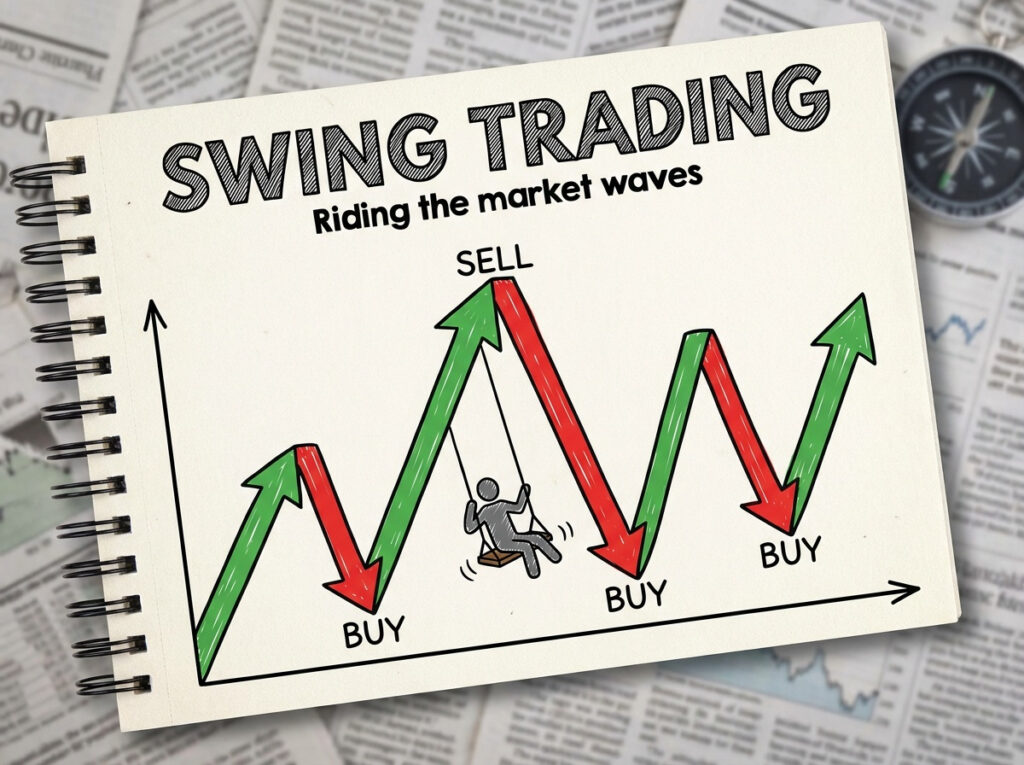
Swing trading
Swing trading holds positions for days to weeks to capture intermediate moves. Traders use daily and four hour charts, structural stops and event awareness. Overnight financing and corporate actions matter for returns. It sits between investing and intraday work, moderate pace, regular monitoring.
Learn more about swing trading.
Day trading
Day trading opens and closes positions inside a single session to avoid overnight exposure. The work focuses on execution quality, tight risk controls and consistent setup repeatability. Costs and slippage compound quickly so round trip cost modelling is essential. Discipline and quick decision making are key.
Scalping
Scalpers take many tiny profits over seconds to minutes. Success depends on very low commissions, minimal latency and a broker that permits rapid in and out. The margin for execution error is tiny so operational reliability is critical. It is an intense, high focus style.
Trend following
Trend followers try to catch in what direction the overall market movement is moving and then ride that to make a profit? The approach tolerates a run of small losses to capture occasional large winners. Trailing stops and position scaling are common tools. It works best in markets with clear, sustained trends.
Mean reversion
Mean reversion strategies bet that prices will return to a statistical norm. Trades often use volatility based stops and tight time windows. This style can deliver steady small wins but is vulnerable in regime changes. Discipline on stop placement and exit rules is essential.
Breakout trading
Breakout traders act when price leaves a prior range or level with conviction. Volume confirmation and retest rules improve signal quality. Breakouts can produce quick strong moves but also false breakouts that whip you out. Clear invalidation rules and sizing guard against repeated losses.
Momentum trading
Momentum trading buys assets that have recently outperformed and sells those that underperform. It can be applied cross sectionally or to single markets and often uses mechanical ranking systems. Momentum performs cyclically and demands robust transaction cost analysis. Rebalancing frequency and slippage control matter.
News and event trading
News trading exploits moves around scheduled or unscheduled releases. The reward is high but the operational risk is larger: spreads widen, liquidity thins and gaps occur. Traders either avoid holding through major events or reduce size and use protective hedges. Fast, reliable data and pre-trade plans are required.
Pairs trading and statistical arbitrage
Pairs trading matches long and short positions in correlated instruments that diverge. It is typically market neutral and relies on mean reversion in relative prices. Good implementations require rigorous backtesting, transaction cost modelling and portfolio breadth. Relationship breakdowns are the main tail risk.
Arbitrage
Arbitrage seeks low risk profit from price differences across venues or instruments. Examples include exchange to exchange price gaps or cross instrument mispricings. True arbitrage margins are small and execution and funding must be near perfect. Opportunities are rare and competition is intense.
Market making
Market makers provide two sided prices and capture spread while managing inventory risk. This requires deep knowledge of market microstructure, capital for inventory and robust risk limits. Market making underpins liquidity but demands sophisticated execution systems and continuous monitoring.
High frequency trading
High frequency trading runs strategies at microsecond to millisecond timescales. The model depends on ultra low latency infrastructure, direct feeds and co location. HFT is capital and technology intensive and usually institutional. It profits from microstructure arbitrage and rebate capture.
Algorithmic and systematic trading
Systematic trading encodes rules into automated systems for signal generation and execution. It ranges from simple automation to complex multi factor portfolios. Key needs are clean data, realistic backtests and robust monitoring with kill switches. Automation enforces discipline but introduces model risk.
Options and derivatives trading
Options trading uses nonlinear payoffs to trade direction, volatility or yield. Strategies include single leg positions, spreads and delta hedged trades that isolate volatility. Understanding greeks, liquidity in strikes and assignment mechanics is essential. Derivatives allow precise risk shaping but add complexity.
Futures trading
Futures are standardized, exchange cleared contracts that give leveraged exposure to indices, commodities or rates. They provide transparent price discovery and daily settlement which reduces counterparty credit exposure. Contract specifications, roll mechanics and margin change behaviour must be understood.
Forex trading
Forex trading covers major and minor currency pairs and runs 24 hours. It offers deep liquidity in majors and many styles are possible from scalping to carry trades. Key operational factors are pip math, rollover financing and broker routing. Forex is sensitive to macro events and session dynamics.
Cryptocurrency trading
Crypto trading spans spot, derivatives and decentralized finance primitives. The market runs continuously and can show high volatility and periodic liquidity evaporation. Custody, exchange solvency and smart contract risk are central concerns. Regulatory treatment varies so counterparty and tax risks must be checked.
Copy trading and social trading
Copy trading replicates another trader’s positions automatically. It reduces operational burden but transfers risk of manager overfit and replication slippage to the follower. Due diligence on track record and replication logic is crucial. Copying is convenience, not a substitute for governance.
Carry trades
Carry trades borrow in low yield funding instruments and invest in higher yield assets to capture interest differentials. They produce steady returns until liquidity or risk aversion spikes force rapid unwinds. Funding risk and correlation to risk appetite require careful margin and scenario planning.
Volatility trading
Volatility trading targets implied versus realized volatility using options or variance instruments. Strategies isolate volatility exposure through hedging or dispersion trades. Volatility can spike rapidly so margin management and liquidity access are vital. Practitioners need a strong quantitative framework.
Prop trading and funded accounts
Proprietary trading firms provide capital under strict rules and profit share. Traders gain scale but accept stringent risk limits, drawdown rules and performance thresholds. Prop models are a pathway to trade larger size with firm level infrastructure but demand consistent results.